
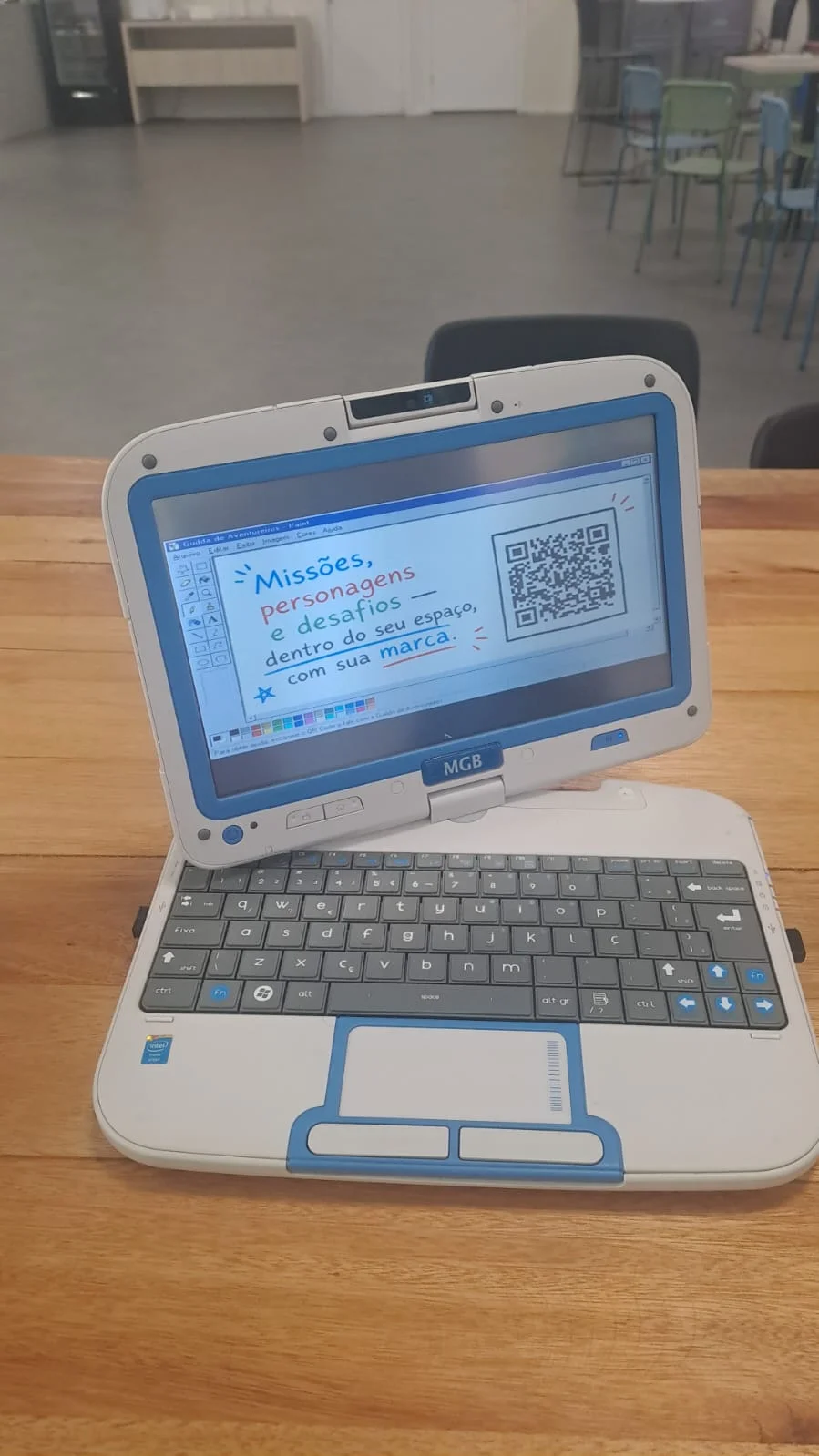
I was not on the Demoday stage. I did not have a booth at ConectaPR 2026 either. So I went with another strategy: walk, observe, talk and carry a 2012 netbook that looked as if it had escaped from a museum display.
It had a beige case, blue trim, a touch screen that rotated horizontally and turned into a tablet. It was not subtle. On the contrary, it seemed to shout: “I am from 2012 — what am I doing here?”
That was exactly the point.
An old machine as a connection strategy
The netbook did not go to ConectaPR merely for nostalgia. I used it to show a Guilda de Aventureiros presentation with the visual style of a Paint screenshot and to use AI tools to record ideas on my home server, with Codex accessed over SSH.
The contrast worked as a natural filter. People who came over were not there out of networking obligation; they had a genuine question. “What is that?” “What do you have there?” “What is that machine doing here?”
Each question opened a conversation about technology, product, artificial intelligence, tourism, games, home servers and, naturally, Guilda and LuneBox.
On the first day, I walked around the event for roughly six hours. At closing time, the netbook still had 5% battery. For a 2012 machine, it was a small endurance feat — and a reminder that technology does not always need to be the newest to create a connection.
When there is no booth, conversation is the product
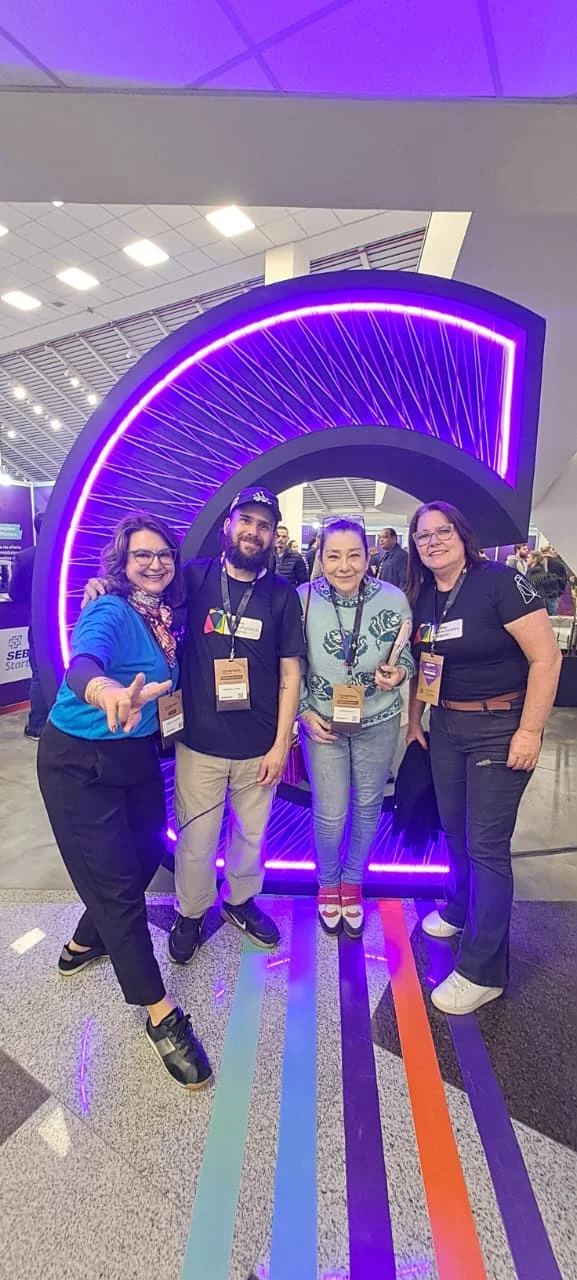
ConectaPR 2026 was held by Sebrae/PR in Curitiba on July 24 and 25, under the concept “Where encounters become action.” Without a fixed structure, Guilda’s participation was mobile: circulate through the spaces, understand what was happening and present the journey whenever a real connection emerged.
This way of being at the event allowed conversations that might not happen in a closed schedule. Guilda’s presentation did not begin with a memorized pitch. It began with the strange object in the backpack and evolved according to each person’s interest.
Conversations that already have next steps
One highlight of the first day was a conversation with Leonardo and Camila from Hotmilk PUC-PR about a possible startup incubation. Guilda is in its validation phase, and discussing incubation environments helps turn hypotheses into a more concrete path for product, market and structuring.
I also spoke with Rhoger, a game developer at Ankouz Studios. For an initiative working with urban tourism, narrative and gamification, exchanging experiences with people who build games is a valuable way to bring product design, engagement and audience language closer together.
With Dornelles, a Sebrae consultant, the conversation was about innovation-funding calls. The recommendation was to look carefully at Finep calls and at the long-term planning needed to participate in support programs, applied research and technological development.
These encounters do not end at the event. All of them will have post-Conecta follow-up. That is the most important part of “encounters become action”: a conversation only gains value when it continues in a meeting, presentation, proposal or experiment.
A funding strategy for a product ecosystem
Guilda de Aventureiros is part of a larger ecosystem: LuneBox. That is why the conversation about funding does not stop at one application; it connects projects at different stages of maturity, from tourism and mobility to GovTech, games and digital platforms.
Current or planned fronts include:
- Programa Centelha 3 Paraná, where Kur-yt-yba — Before Us was submitted;
- Hub GovTech Paraná, where Dados-Turismo qualified for phase 0 of the acceleration program and ConcilWorks — previously documented as DTI Platform — is being prepared for the incubation track;
- the SETI/Fundo Paraná — AGEUNI public call, in which Guilda participates as the applicant for Demand 42 on inclusive and sustainable mobility;
- the Mais Turismo call from Itaipu Parquetec, followed as an opportunity for applied innovation in tourism;
- an intention to assess fit with iFood Chega Junto, an initiative focused on social-innovation projects that affect delivery workers and their communities.
Each of these doors has its own objectives, rules and stages. Being submitted, qualified or under discussion does not mean funding has been approved or a product is ready. It means keeping a routine of looking for paths that fit each problem, team and stage of maturity.
A TravelTech workshop and new possibilities
The second day of ConectaPR was marked by the TravelTech workshop. The discussion broadened the understanding of technology in tourism: it is not only about the traveler journey, but also data, sustainability, operational efficiency, accessibility and new relationships among guests, attractions and local commerce.
The TravelTech discussion led to a proposal for a cultural-experience pilot for hotel guests, using literary tourism as a first entry point. The proposal is still being articulated and validated, but it reinforces an important idea: an event conversation can reveal a specific problem and create room to test a real solution.
After the workshop: Guilda in conversation
After the workshop, conversations with other participants created space to present Guilda de Aventureiros and its journey. At that point, we talked both about LuneBox’s involvement in accessibility projects and about Guilda’s relationship with geek audiences, narrative and gamification.
A book to continue the conversation
On arrival, I received the second edition of Eu, Empreendedor by Léo Mack, published by Editora Gente. Its subtitle speaks directly to the moment many people at the event were living: “an entrepreneurship guide for those who love what they do but do not get moving.”
The book joins the reading queue and will be the subject of a dedicated article. For now, it is a useful reminder of ConectaPR’s spirit: liking an idea is the beginning; putting it in motion requires conversations, tests, focus and continuity.
The presence I wanted to build
I left ConectaPR with contacts, follow-up possibilities and new questions. Above all, I left with confirmation that presence at an innovation event does not depend only on having a booth or being on stage.
Sometimes it starts with an old machine, an imperfect presentation, a server at home and a willingness to explain what you are building. The netbook drew attention. The conversations showed what can happen afterwards.